




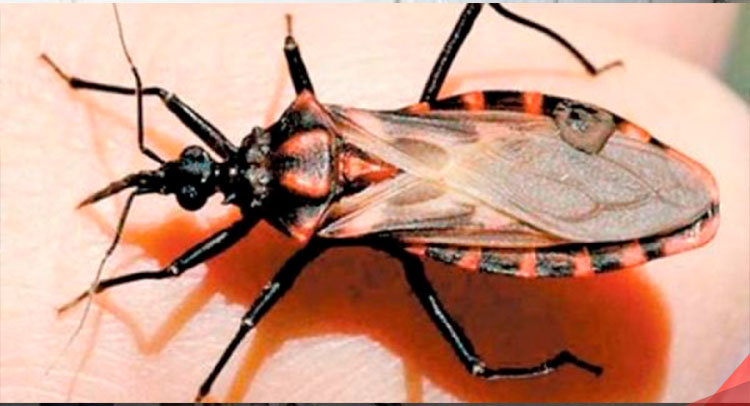
Thoroughly cleaning patios and using sleeping pavilions could significantly reduce the cases of Chagas disease in Yucatan, said Juan Ortiz Rivera, state manager of the Chagas program of the Ministry of Health of Yucatan (SSY) .
The specialist said that these traditional habits have been forgotten little by little, increasing the risk of the presence of the parasites that generate this disease, which puts thousands of people in risk in Yucatan.
“It is important to keep the patio clean and you can also fumigate houses, a practice that has been left undone. This helps up to 60% to reduce contact with the bug. You can also return to the use of pavilions, since this avoids contact with the insect, mainly in children,” he explained.
The specialist explained that the parasite feeds on blood, so it tends to prey on backyard animals and other domestic animals, although he said that it can also consume human blood.
“When there are backyard animals there is a possibility that there may be bed bugs, especially in the interior of the state. It is recommended to keep animals away, as well as cleaning items in the house,” he said.
He mentioned that the insects carrying the parasite that causes Chagas disease transmit it through their feces when the host scratches, causing the inoculation, although he explained that not all insects are carriers.
He explained that in its acute phase, the parasite begins to reproduce for 45 days in which there are some symptoms such as high temperature, weight loss or discomfort, although not all cases present them.
In the asymptomatic phase, he mentioned, there are no symptoms for up to 20 years, although in the chronic phase, the parasite has already lodged in an organ such as the heart or liver, which can lead to the death of the person.
As of May 12 the National Epidemiological Surveillance System (Sinave) had confirmed six cases of Chagas disease in its acute phase, of which there are 3 women and 3 men, compared to 2017 when during the same period no case was recorded.
In its chronic phase, there are 14 so far this year, according to the Sinave, less than the 27 reported at the same time the previous year.
In that tenor, Ortiz Rivera asked citizens to be aware of two key points: if they have been bitten, there is an inflammation of the eyelid, when the bite occurred near the face. The second is that the bite that it leaves is large, irritated and causes discomfort for seven days.
“It is important to identify the risk in the acute phase. If there is contact with the bug, it is important to notify the Chagas program, so that we can take a sample and rule out if you have the parasite.”
“If you see a bug, it can be eliminated with an insecticide and discarded with a plastic bag, avoiding contact with the skin,” he said.
He said that there are representatives of the Chagas program that go to verify the conditions of the type of home of the person, in a suspicious case, while it is also verified that a blood test is done to confirm if this is positive.
Then, it is determined if the patient is a candidate for the treatment in which antiparasitics are applied or through an organic method to combat them.
Text: ACOM
Photo: Courtesy

