





Text and photos by Robert Adams
Gail Weaver recalls arriving in Mérida on the November night in 2008 when Barack Obama was elected U.S. president. Originally from San Diego, Calif. by way of Los Cabos in Baja California Sur, Weaver immediately started to search for places in Merida to buy what she calls “good” food.
Buying and consuming healthy, chemicals-free, locally-sourced and fairly-priced food was a pursuit Weaver brought with her to Merida from California, a bedrock of the “Slow Food” movement founded in Italy in the early 1980s by Carlo Petrini.
According to the Slow Food website, Petrini’s initial aim was to defend regional traditions, good food, gastronomic pleasure and a slow pace of life. The movement has evolved to embrace a comprehensive approach to food recognizing strong connections between plate, politics and culture. Today Slow Food encompasses thousands of projects and millions of people in over 160 countries.
Thanks to Weaver, the late chef David Stirling, agronomist-farmer Aliza Mizrahi and several other expats with similar passion for “good” food, Merida has become a hotbed of the Slow Food scene. The Yucatecan soil has proved fertile ground for this movement, which in Merida is focused on a weekly market held every Saturday morning in and around the Ciné Colón strip-shopping plaza in Colonia García Ginerés.
“We have about 50 vendors every weekend,” Weaver noted as she provided an informal tour of the colorful stands and stalls featuring everything from organic honey to slow-fired tacos. “We are at capacity now, and we have to be very selective in accepting new vendors.”
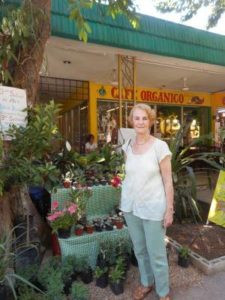
Pausing to greet a woman and her young son selling organic eggs, Weaver went on to note the Slow Food Yucatan market attracts an impressive average of 300 to 400 customers each Saturday morning.
In addition to browsing, buying and consuming a variety of appetizing produce and food products, the customers – who are a mix of foreign-born expats and native Mexicans – come very purposefully to converse and socialize with each other.
In that sense, the market has emerged as a unofficial expat meeting ground as well as point of common contact between Merida’s growing expat community and native-born residents.
“When it first started, the market was all expats. Now it’s about 50-50 between Mexicans and expats,” Weaver said. “A lot of people come to learn about healthy food and lifestyle. And a lot of Mexicans come to practice their English,” Weaver noted as she stopped to view a stand displaying verdant succulent plants.
With a chuckle, Weaver noted that Slow Food Yucatan has emerged as the Saturday “place to be” for expats because “women feel comfortable here, and where the women are, men will follow.” She said the fact the market is a gathering not focused on alcoholic beverages makes it appealing to many women who might otherwise feel intimidated.
Whatever the various reasons for its popularity, Slow Food Merida is a great way to spend a few hours on a Saturday morning.
For more information, visit Slow Foods Yucatan’s Facebook page.
–By Robert Adams

